Part of our guide: AI Calling in India: The Complete 2026 Guide
Key takeaways
- BANT asks four things: can they pay, who decides, what problem they have, and when they want it solved.
- On the phone, ask in the order Need, Timeline, Authority, Budget. Money comes last, once the lead has told you what they want.
- Ask budget as a range or a choice of options, never as "What is your budget?"
- In many Indian purchases the decision-maker is a spouse, parent or business partner. Plan the next step around them instead of marking the lead weak.
- Score with simple rules (hot, warm, nurture, not a fit) and give hot leads to a person the same day.
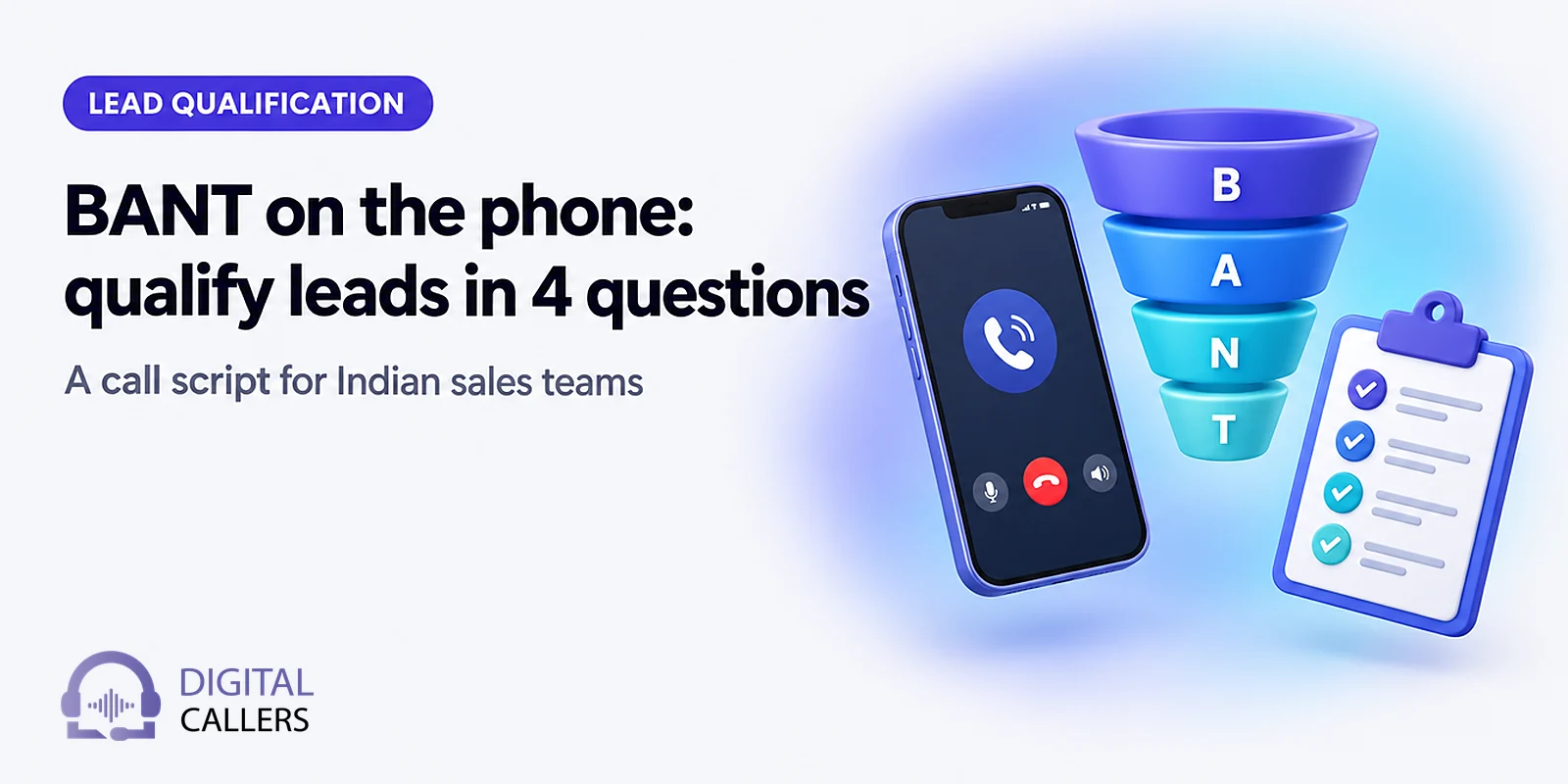
BANT is a four-part check, Budget, Authority, Need and Timeline, that tells a sales team which leads deserve a call back today and which can wait. In India, qualification usually happens on a phone call with someone who filled an Instagram form twenty minutes ago, often in Hinglish, often sitting with family. This guide turns BANT into that call: four spoken questions, polite budget lines, family decision-makers, a scoring table, and how our AI lead qualification agents run it on the first call.
What is BANT, and where did it come from?
BANT is a sales qualification checklist with four criteria: Budget, Authority, Need and Timeline. A lead that scores well on all four deserves a salesperson's time now. The BANT framework is popular because it is short and easy to train a new telecaller on.
It is widely attributed to IBM. We could not find a primary source showing exactly when or by whom it was first coined, but IBM's own partner programme documents used it: a 2008 IBM "Budget Authority Need Timeframe (BANT) Criteria Template" asked partners registering a sales opportunity to describe whether and when the budget was or would be approved, name a C-level or line-of-business decision-maker (procurement contacts did not count), state the customer's business problem, and give decision milestones with a forecast close date. That is BANT in its enterprise form: a gate before a deal enters the pipeline.
For an Indian SME, the idea carries over; the paperwork does not. You need the same four answers from a two-minute conversation.
Why should BANT be a phone call for Indian sales teams?
Because most Indian leads arrive with almost no information. A lead ad form gives you a name, a number and maybe a city. The four BANT answers only come out in conversation.
It also fits the time you have. On our platform, recent sales conversations in October 2026 had a median of about 122 seconds (a small sample). Four short questions and a next step fit inside two minutes; a ten-question script does not.
Speed matters too. A lead called within minutes still remembers the form. A lead called the next day may already be talking to someone else.
What are the four BANT questions, written for the phone?
The four lead qualification questions are: what do you need, by when, who else decides, and which budget range suits you. Ask them in that order, one per turn, and add a short "thank you, that helps" between them so the call feels like a conversation, not a form.
Here they are as spoken lines. Bracketed parts change per business.
| BANT step | English line | Hinglish line |
|---|---|---|
| Need (ask first) | "You'd asked about [product]. What are you hoping it will solve for you?" | "Aapne [product] ke baare mein poocha tha. Aapko kis cheez mein help chahiye?" |
| Timeline | "When would you like to get started: this month, in the next two or three months, or are you still exploring?" | "Aap kab tak shuru karna chahenge? Is mahine, agle do-teen mahine mein, ya abhi bas dekh rahe hain?" |
| Authority | "Will you be deciding this yourself, or is someone else involved too?" | "Yeh decision aap khud lenge, ya ghar mein ya partner se bhi baat karni hogi?" |
| Budget (ask last) | "Our options start around [₹X] and go up to about [₹Y]. Which side are you closer to?" | "Hamare options [₹X] se [₹Y] tak hain. Aap kis range mein soch rahe hain?" |
Why this order? Opening with budget feels like a gate, and people answer defensively. Opening with need shows you read their enquiry. By the time you reach budget, you can offer a range that matches what they described.
For the full call around these lines (opening, permission question, goodbye), use our AI calling script template.
How do you ask about budget without sounding rude?
Ask with ranges or options, not an open question. "What is your budget?" makes people guess, lowball or refuse. "Our courses run from ₹40,000 to about ₹90,000; which suits you better?" gives them a frame and tells you in one answer whether they fit.
Three ways that work on Indian calls:
- Offer a range. "Most families choose between ₹X and ₹Y." The lead picks a side without naming a number.
- Offer two or three options. "We have a weekend batch, a regular batch and a one-to-one plan. Which sounds closer?" Each option carries a price, so the choice is a budget answer.
- Ask about payment, not amount. "Would you pay at once, or would EMI suit you better?" Easier to answer than a figure, and it tells your team what to prepare.
Accept "pata nahi abhi" ("not sure yet") gracefully; it is a note for the salesperson, not a disqualification. Speak up only when the gap is obvious: if a lead wants a ₹5,000 solution and your cheapest option is ₹50,000, it is kinder to say so on the first call than after three follow-ups.
Why is "authority" in India often a family or partner decision?
Because many purchases in India are decided jointly, even when one person fills the form. A home loan often has a co-applicant. A coaching course for a teenager is chosen by parents. A shop owner checks with a partner or the father who started the firm. The person on the phone is often an influencer, not the decider.
So "I'll ask my husband" or "Papa se baat karni hogi" is not a weak answer. It is useful information. Bring the decider into the next step:
- "Kya hum aisa time fix karein jab aap dono baat kar sakein?" ("Shall we fix a time when both of you can talk?")
- "Should I send the details on WhatsApp so you can share them at home tonight?"
- "Would your partner like to join the demo on Saturday?"
The 2008 IBM template insisted on a named executive. On an Indian SME call, a softer version works better: learn the decider's role and get them into the next conversation.
What timeline signals should you listen for?
Listen for a date tied to an event. "Before Diwali", "our software contract ends in June" and "flat shortlisted, loan chahiye is mahine" all signal a real deadline. "Just checking", "maybe next year" and "send details, I'll see" signal a lead to nurture, not chase.
Signals worth writing down:
- An external deadline: an exam date, a registration or possession date, a contract renewal, a wedding.
- A step already taken: shortlisted a property, compared two institutes, sat through a demo elsewhere.
- A trigger event: a new branch, a bad experience with the current provider, a doctor's referral.
- Vague language: "dekhte hain", "baad mein batata hoon", "abhi idea le rahe hain". Not a no, but not now either.

How do you score BANT answers: hot, warm, nurture or not a fit?
Use a few plain rules instead of points. Need is the gate: no real need means not a fit, whatever the budget. After that, timeline and budget decide how hot the lead is, and authority decides who must be on the next call. Keep the rules simple enough to explain.
| Score | Rule | What happens next |
|---|---|---|
| Hot | Clear need, timeline within about 30 days, budget fits a range you offer, decider on the call or reachable | Salesperson calls back the same day; booking offered on the first call where possible |
| Warm | Clear need, budget fits, but timeline is one to three months or the decider is not yet involved | Book a call or demo with the decider present; follow up within the week |
| Nurture | Need is real but timeline is vague or beyond three months, or budget is unclear | WhatsApp information and a scheduled call-back at the time they gave |
| Not a fit | No real need, budget far below your lowest option, or outside your service area | Thank them, close politely, and mark the reason so marketing can fix targeting |
Set the windows for your own sales cycle; a clinic might think in days, a software firm in months. Log the reason for every "not a fit": if most say "outside service area", fix your ad targeting, not your callers. Our guide to junk leads from Facebook ads covers that side.
What does BANT sound like in four Indian industries?
The questions stay the same; only the words change. These are hypothetical examples with made-up names. For a deeper industry version, our guide to solar lead qualification adds the questions that only rooftop solar needs.
Home loans (Lucknow). Say a loan DSA calls Sameer Khan. Need: "Aap naya ghar le rahe hain ya existing loan transfer karna hai?" He has shortlisted a flat (strong timeline signal). Authority: his wife will be the co-applicant. Budget becomes loan amount and EMI comfort: "Monthly EMI aap kitni range mein rakhna chahenge?" Hot, with a call-back booked for when both are home.
Coaching (Pune). Say an institute calls Meera Joshi about a foundation course for her son in Class 9. Need: which exam and which subjects. Timeline: the new batch starts in April. Authority: Meera and her husband decide together. Budget: weekend batch or regular batch. Warm, with a counselling slot booked for the family.
B2B software (Bengaluru). Say a billing software company calls Arjun Rao, operations manager at a 40-person distributor. Need: GST invoicing is done manually and errors are rising. Timeline: the current licence ends in June. Authority: the owner signs after the accountant agrees. Budget: per-user plan or annual licence. Warm until the owner joins a demo.
Clinics (Jaipur). Say a dermatology clinic calls Kavita Sharma about laser treatment. Need: she describes the concern; the agent gives no medical advice. Timeline: before a family wedding in two months. Authority: she decides. Budget: the consultation fee and a package range from the clinic's price list. Hot. See AI calling for specialty clinics.
How does an AI agent ask BANT on the first call and hand over hot leads?
An AI agent calls within minutes of the enquiry, asks the four questions one per turn in the lead's language, writes each answer and the score to your sheet or CRM, and flags hot leads for your team. Here is how we set it up:
- We build the agent on your script and approved facts. Price ranges come from a locked facts sheet, so the agent quotes your numbers.
- We connect your lead source. Google Sheets, Facebook and Instagram lead ads, your CRM or a webhook.
- The agent asks in the lead's language. Hindi, English, Hinglish, Marathi, Kannada, Tamil, Telugu or Bengali.
- Answers go into columns, not a paragraph. Need, timeline, decider, budget range and score each get their own field.
- Hot leads go to a person. Each record carries an outcome, summary, recording and transcript, so your salesperson calls back already knowing the answers. A manager can also listen live, whisper or take over on the live monitor.
- A WhatsApp confirmation follows for any call-back or appointment agreed on the call.
The agent should not negotiate price, argue, or judge a lead "not serious" from tone alone. Those stay with your team; see our guide to objection handling on sales calls.
Skip any BANT question the form already answered. If the form asked when they plan to buy, the agent confirms it ("You mentioned within a month, still right?") instead of asking again.
Where does BANT break for small-business and consumer buyers?
BANT breaks when budget is not fixed in advance, when the buyer has not yet named a need, or when one answer decides everything. Many consumers and small business owners have no "budget", only a sense of what is reasonable that shifts once they see value.
Adjust in three ways:
- Lead with need and timeline, and treat budget as a range check, not a pass or fail.
- Replace "authority" with "who else should hear this?" In a family or a three-person firm, nobody holds formal authority; the decision is shared.
- Do not disqualify on one answer. A student with no budget clarity but a fixed exam date is a nurture, not a reject.
Other frameworks exist. CHAMP (Challenges, Authority, Money, Prioritisation) puts the buyer's problem first and money later, much like our order above. MEDDIC (Metrics, Economic buyer, Decision criteria, Decision process, Identify pain, Champion) is built for long B2B deals with several stakeholders, too heavy for a first consumer call. For most Indian SMEs, BANT first and something deeper only for big deals is a sensible split.
How do you put BANT to work this week?
Start small and test on real leads before you scale.
- Write the four lines in your leads' main language, Need first and Budget last.
- Write two or three budget ranges from your actual price list.
- Set your timeline windows for hot, warm and nurture to match your sales cycle.
- Add five columns to your lead sheet or CRM: need, timeline, decider, budget range, score.
- Listen to 20 calls and change one line at a time.
- Check "not a fit" reasons weekly with your ads team.
A two-minute qualification conversation costs roughly ₹12–16 on our plans, plus 18% GST, billed in 30-second pulses, with unanswered calls not billed. See pricing for plan minimums and the setup fee.
BANT works best as a helpful conversation, not a checklist read aloud. To have every new enquiry asked these four questions within minutes, in your leads' language, see AI lead qualification. Book a 20-minute demo and we'll call your phone with an agent set up for your business.
Frequently asked questions
What does BANT stand for in sales?
BANT stands for Budget, Authority, Need and Timeline (some versions say Timeframe). It is a checklist for deciding whether a lead is worth a salesperson's time: can they pay, can they decide, do they have a real problem you solve, and when do they want it solved. It is widely attributed to IBM, whose partner documents used BANT criteria to register sales opportunities.
In what order should BANT questions be asked on a call?
On the phone, ask Need first, then Timeline, then Authority, and Budget last. Opening with money feels like a filter and puts people on guard, while opening with their problem shows you were listening to the enquiry. By the time you reach budget, the lead has already told you what they want, so a price range sounds like help rather than a test.
How do you ask a lead about budget without sounding rude?
Give ranges or options instead of asking for a number. Saying 'Our plans run from about X to Y, which side are you closer to?' lets the lead answer without revealing exact figures, and it tells you at once whether they are in your range. Accept 'not sure yet' and move on; one unclear answer does not disqualify a lead.
Is BANT still useful, or should we use MEDDIC or CHAMP instead?
BANT is still a good first-call filter for high-volume enquiries, because it is short and easy to train. MEDDIC suits long, complex B2B deals with several stakeholders, and CHAMP starts from the buyer's challenges rather than budget. Many Indian teams use BANT on the first call and a deeper framework only for deals that progress.
Can an AI voice agent qualify leads using BANT?
Yes, an AI agent can ask the four BANT questions on the first call, one per turn, in the lead's language, and write each answer and a score to your sheet or CRM. Hot leads are flagged with a summary and recording so a salesperson calls them first. Price negotiation, complex objections and final decisions should stay with your team.
We build and run AI calling agents for Indian businesses from Gurugram, in Hindi, English and regional languages. Our articles draw on calls we have run ourselves and link to primary sources such as TRAI, DoT and MeitY for anything regulatory. Spotted something out of date? Write to support@digitalcallers.com.
See it on your own leads
In a 20-minute demo we set up an agent for your business and call your phone while you watch.