Part of our guide: AI Calling for Real Estate in India: Enquiry to Site Visit Playbook
Key takeaways
- Write turns, not paragraphs: one or two sentences, one number, then stop and let the customer speak.
- Use the customer's name with "ji" or "avare". Never assume "Sir" or "Ma'am".
- Ask permission early and always offer an easy "call me later" option.
- Keep facts in a locked sheet per project or product so the agent cannot mix prices and locations.
- Every call ends with a goodbye, and the platform should wait for it to finish before hanging up.
An AI calling script is not a speech. It is a set of short turns: a greeting, a permission question, a few discovery questions, one-fact answers and a clear next step, written so a voice agent can say them naturally and recover when the customer interrupts. Most scripts we receive from businesses are written to be read, not heard. This guide shows how we rewrite them, the mistakes our own testers caught on real Indian calls, and a fill-in-the-blanks template you can copy today.
What makes an AI calling script different from a telecaller script?
A telecaller script is a guide that a trained person shortens, skips and improvises around. A script for an AI agent is a map of turns: what to say first, what to ask next, and which fact to give when asked. The agent follows it faithfully, so anything long, vague or repeated shows up on the call.
Give a five-line paragraph to a human and they pause, check the customer is listening, and drop half of it. An agent says all of it, which sounds like a recorded advert.
| Element | Typical telecaller script | Script for an AI agent |
|---|---|---|
| Unit of writing | Paragraphs and talking points | Single turns of one or two sentences |
| Facts (prices, locations, timings) | Mixed into the pitch | Kept in a separate, locked facts sheet |
| Objections | A few lines at the end | Short, ready answers the agent can reach at any point |
| Language | Usually one | Default language plus switching on a full sentence |
| Ending | "Thank you, have a nice day" | Confirms the next step, then a goodbye before hang-up |
Why do most AI voice agent scripts sound robotic?
Most robotic-sounding calls come from the script, not the voice. Long turns, several numbers in one breath, the same line said twice, and the wrong form of address all make a natural voice sound mechanical. Fix the writing first. Voice speed and tone settings matter far less than most people expect.
A sales manager who tests our calls tells us bluntly what feels wrong. Here is what came up, and what we changed:
- Long monologues feel rushed, even at a normal speaking speed. We moved to one or two sentences and one number per turn, then stop.
- "Hello?" mid-sentence caused repetition. A naive agent restarted its whole line. Shorter turns cured most of it.
- Calling a woman "Sir" repeatedly is a real failure in Indian calls. We use the name with "ji" (or "avare" in Kannada) and never assume gender.
- Saying the same thing in two languages back to back sounds broken. The agent switches only on a full sentence in another language, not on a stray "hello" or "haan".
- The opening line must be in the right default language. In one setup, a wrong language setting at the very start made the agent go silent until we fixed it.
- Never hang up without a goodbye. Our platform now holds the hang-up until the goodbye has finished playing.
None of this is new to conversation designers. Google's conversation design guidance puts it plainly: "saying too much is as uncooperative as saying too little," and a voice persona "should not monopolize the conversation" (Google, Learn about conversation).
The 7 building blocks of a human-sounding call
A good AI voice agent script has seven parts: an opening that says who is calling and why, a permission question, two or three discovery questions, short answers with one fact each, ready objection replies, a booking step, and a warm goodbye. Each part is written as turns, and each turn ends with a question or a pause.
1. Opening
Name the customer, your business and the reason: "Namaste Priya ji, main ABC Homes se bol rahi hoon. Aapne kal plots ke baare mein enquiry ki thi." (Names here are examples.) Mentioning the enquiry separates a welcome call from a cold one.
2. Permission
Ask if now is a good time, and mean it. If not, the agent asks when to call back and schedules it for that time.
3. Discovery
Two or three questions, one per turn: what they want, for whom, and roughly when. The answers decide which facts come next.
4. One fact per turn
Asked the price, give the price, not the price, size, location and offer together. This is the biggest change most scripts need.
5. Objection handling
Write a short reply to each common objection. Each reply acknowledges, gives one useful fact, and returns to the next step.
6. Booking
Offer two specific options: "Saturday 11 baje ya Sunday 4 baje?" Confirm the slot back in one line.
7. Goodbye
Repeat the next step, thank them by name, say goodbye, and let it finish before the call ends.
The AI calling script template (copy and fill in)
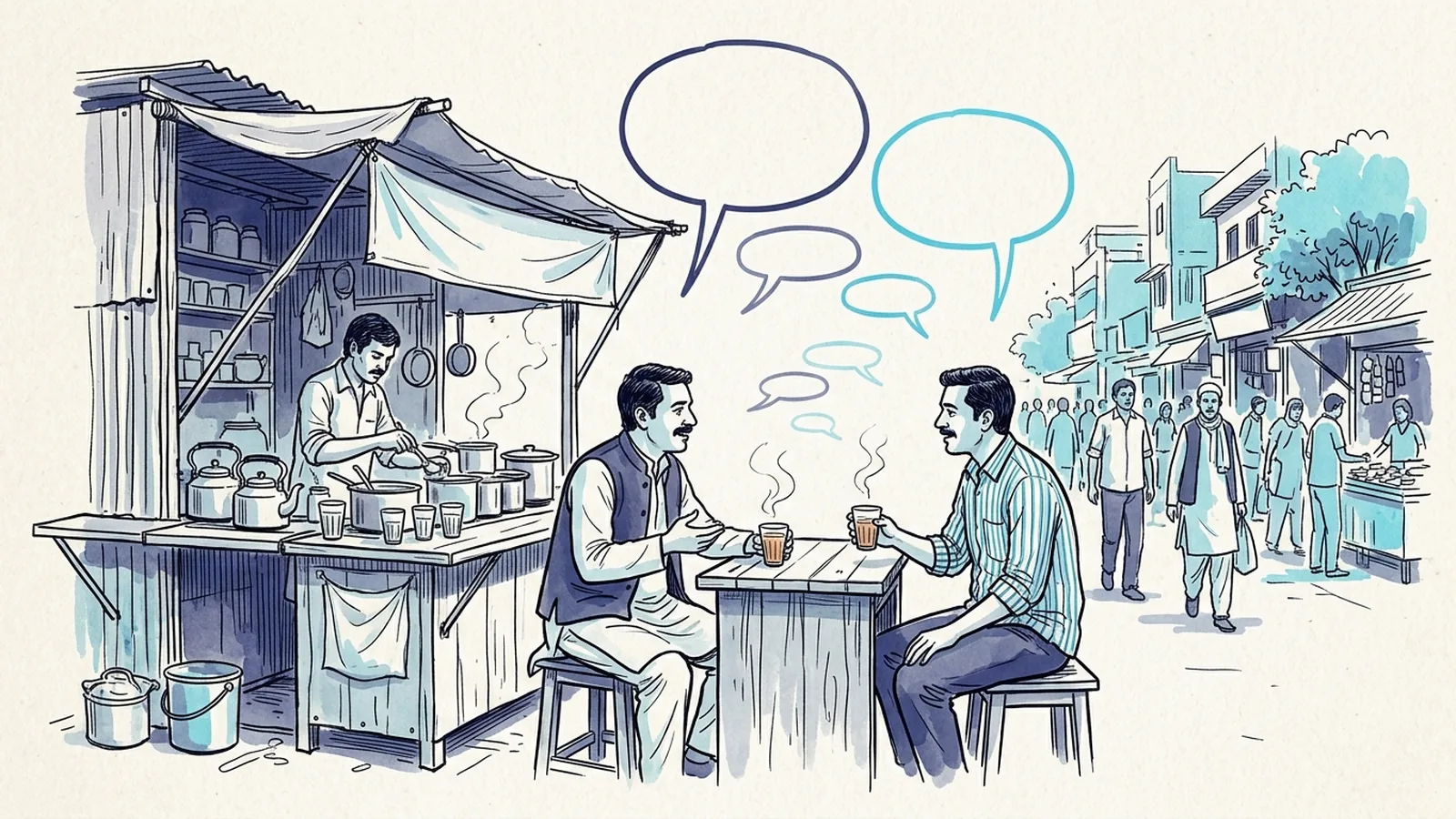
Use this template as the main flow of your AI calling script. Replace everything in square brackets, keep each line as one turn, and keep prices, addresses and timings in your facts sheet, not the flow. The agent pulls from the facts sheet only when the customer asks.
```text OPENING Agent: Namaste [First name] ji, main [Agent name] bol rahi hoon, [Business name] se. Agent: Aapne [where they enquired: Instagram ad / website / event] par [product or project] ke baare mein enquiry ki thi.
PERMISSION Agent: Kya abhi do minute baat ho sakti hai? If no -> Agent: Koi baat nahi. Aapko kab call karna theek rahega? [Schedule call-back at the time given] -> GOODBYE
DISCOVERY (one question per turn, stop after each) Agent: Aap [product] apne liye dekh rahe hain ya family ke liye? Agent: [Second qualifying question, e.g. budget range / preferred area / course start date] Agent: [Third question, only if it changes what you offer]
ANSWERS (from the facts sheet, one fact per turn) Customer asks price -> Agent: [One price or price range]. [One short follow-up question] Customer asks location -> Agent: [One-line location]. [One short follow-up question] Customer asks anything not in the facts sheet -> Agent: Yeh main team se confirm karke aapko batati hoon. [Note it for the team]
OBJECTIONS "Too expensive" -> Agent: Samajh sakti hoon. [One fact about value or options]. [Return to next step] "Send details on WhatsApp" -> Agent: Bilkul, bhej deti hoon. [One question that keeps the call useful] "Just looking" -> Agent: Theek hai ji. [Low-commitment next step, e.g. a visit with no obligation] "Need to ask family" -> Agent: Zaroor. Kya family ke saath [visit / call] fix kar dein?
BOOKING Agent: [Option A day and time] ya [Option B day and time], kaunsa theek rahega? Agent: Done. [Day], [time], [place or call]. [One practical detail, e.g. pickup point]
GOODBYE Agent: Dhanyavaad [First name] ji. [Next step in one line]. Aapka din shubh ho. [Wait for the goodbye to finish before ending the call] ```
The template is written in Hinglish as an example. For an English or Kannada default, translate it turn by turn and keep the same shape. If you would rather not start from a blank page, our call strategy templates cover common call types, and we adapt them to your own scripts and FAQs during setup.
How do you write your own script, step by step?
Start from the goal of the call, not from your brochure. Write down the one outcome you want, collect the facts the agent may need, draft short turns around them, then test with real people and revise from recordings. Drafting is the quick part; the script gets good only once you have listened to real calls.
- Write the goal in one line. "Book a site visit" or "confirm the order". Every turn should move towards it.
- Build the facts sheet, one per project or product. We introduced this after an early real-estate setup where one agent loaded facts from several projects and mixed up their prices and locations.
- Draft the flow in turns. Use the seven blocks above. Read every line aloud; if you need a breath in the middle, split it.
- List eight to ten objections in your best salesperson's words, with a two-sentence reply to each.
- Set the default language your leads use most, and the switching rule.
- Test with real callers. Colleagues play difficult customers: interrupt, switch language, ask something not in the facts sheet. Listen on the live monitor and step in if needed.
- Revise weekly from transcripts, one change at a time.
What changes in a sales call script template for India?
A sales call script template for India has to handle mixed languages, respectful forms of address, and Indian rules on commercial calls. That means Hinglish or a regional default, the name with "ji" instead of "Sir", a clear statement of who is calling, and an easy way for the customer to say no.
Address is what imported templates most often get wrong. The first name with "ji" works across Hindi, Hinglish and most English calls; in Kannada, "avare" does the same job. Our agents speak Hindi, English, Hinglish, Kannada, Marathi, Tamil, Telugu and Bengali; our guide to multilingual AI calling explains switching.
Rules matter too. TRAI's 2025 amendment to its commercial communication regulations keeps the 140 series for promotional calls, designates a new 1600 series for transactional and service calls, and lets customers report spam within 7 days instead of 3 (TRAI press release No. 11 of 2025). A script that says clearly who is calling and why, and respects a "no", keeps complaints down. Our summary of the TRAI anti-spam rules for automated calls covers the detail. This is general information, not legal advice.
Does an AI cold calling script work?
An AI cold calling script can be written, but AI calling is the wrong tool for most cold lists. It works best on warm leads: people who filled a form, called you, or are existing customers. On cold, purchased lists, answer rates fall, complaints rise and the regulatory risk is higher.
For context: across 42,879 outbound calls on our platform from May to October 2026, mostly to warm enquiries, about 61% lasted 15 seconds or more. That is a proxy for connection, not a verified pickup rate; it mixes campaign types, and results vary by industry, list quality and time of day. We would not expect a cold list to match it.
Common mistakes when writing scripts for AI agents
Most script mistakes come from writing for the eye instead of the ear: too much in one turn, facts mixed into the pitch, and no room for the customer to speak. These are the ones we see most in existing telecaller scripts.
- Pasting the brochure into the script. Facts belong in the facts sheet.
- No permission question. Busy customers hang up, and you lose the call-back.
- One agent for several projects. Use one agent per project, each with its own locked facts.
- Ending abruptly. A call cut off without a goodbye feels rude.
Read your script to a colleague over a real phone call, not across the desk. Every place they say "hmm?" is a turn that needs splitting.
Short scripts also cost less. A sales conversation of about two minutes costs roughly ₹12–16 on our pricing, and short confirmation calls under a minute cost ₹3–8. For how scripts fit into a full lead-to-visit process, see our AI calling playbook for real estate.
A good AI calling script is short, polite and specific: one turn at a time, one fact at a time, with the customer's name and a clear next step. Start from the template above, test it with real voices, and keep trimming. If you would like to hear one working, book a 20-minute demo and we'll call your phone with an agent set up for your business.
Frequently asked questions
How long should an AI calling script be?
Think in turns, not pages. Each turn should be one or two sentences with at most one number, and the whole planned path to booking should fit in about two minutes of conversation. The agent also needs short answers to your eight to ten most common questions, kept in the facts sheet rather than the main flow, so it can reply without reading a paragraph.
Can I use my existing telecaller script for an AI voice agent?
You can start from it, but expect to rewrite most of it. Telecaller scripts assume a human will skip, shorten and improvise. An AI voice agent says what it is given, so long paragraphs come out as monologues. Break every paragraph into single turns, move facts into a locked facts sheet, and add a clear question at the end of each turn.
Should the script be in Hindi, English or Hinglish?
Pick the default language your leads most often use and open in it, because a wrong opening language is the hardest mistake to recover from. Then let the agent switch when the caller speaks a full sentence in another language. Our agents work in Hindi, English, Hinglish, Kannada, Marathi, Tamil, Telugu and Bengali.
Does an AI cold calling script work on purchased lists?
We do not recommend it. AI calling works best on people who asked to hear from you: ad enquiries, website forms, existing customers and call-backs. Cold lists bring low answer rates, more complaints and regulatory risk under TRAI rules on unsolicited commercial communication. Use the script on warm leads first and measure from there.
How often should I change my AI calling script?
Review it weekly for the first month. Read transcripts of calls that ended early, calls where the customer said 'hello?' or repeated a question, and calls that ended in a booking. Change one thing at a time, such as a shorter opening or a new objection answer, so you can see what actually made the difference.
We build and run AI calling agents for Indian businesses from Gurugram, in Hindi, English and regional languages. Our articles draw on calls we have run ourselves and link to primary sources such as TRAI, DoT and MeitY for anything regulatory. Spotted something out of date? Write to support@digitalcallers.com.
See it on your own leads
In a 20-minute demo we set up an agent for your business and call your phone while you watch.