Part of our guide: AI Calling for Real Estate in India: Enquiry to Site Visit Playbook
Key takeaways
- A site survey costs a technician's time and fuel; qualify by phone first and survey only the leads that can actually install.
- Six questions do most of the work: ownership and roof rights, monthly bill, connection and DISCOM, roof and shade, payment plan, decision-maker and timing.
- Explain the PM Surya Ghar subsidy with the official numbers (₹30,000 for 1 kW, ₹60,000 for 2 kW, ₹78,000 for 3 kW or more) and never call it guaranteed.
- Call within minutes of the enquiry, while the person still remembers filling the form.
- Book the survey on the same call and hand the surveyor the answers.
Solar lead qualification decides how well your installers spend their week. Every rooftop solar enquiry looks the same in a lead sheet: a name, a number, a city. On the phone, the differences show up within two minutes. One caller owns an independent house with a ₹4,000 monthly bill. Another rents a second-floor flat and saw an ad about "free electricity". Six questions tell them apart before anyone drives out for a site survey.
Why does solar lead qualification matter so much?
Solar leads are cheap to collect and expensive to serve. A form fill costs little; a site survey costs a technician's half-day, travel and follow-up. Qualifying on the phone means surveyors visit homes that own their roof, have a bill worth reducing and a decision-maker ready, instead of chasing curious browsers.
Interest in rooftop solar in India is strong because of the government's push. The Union Cabinet approved PM-Surya Ghar: Muft Bijli Yojana in February 2024 with an outlay of ₹75,021 crore to help one crore households install rooftop solar. A December 2024 MNRE update on PIB set a target of one crore installations by March 2027. That publicity brings in plenty of enquiries, and plenty of them are from people who cannot install yet: tenants, flat owners without terrace rights, or households with very low consumption.
Whether your rooftop solar leads in India come from Facebook and Instagram lead ads, Google forms or website enquiries, they go cold quickly. The first call should happen within minutes, which is where an AI agent helps: we check a connected Google Sheet every two minutes and call new rows straight away. Our guide on calling Facebook leads automatically from Google Sheets shows the setup.
What are the 6 questions that qualify a rooftop solar lead?
Ask about ownership and roof rights, the monthly electricity bill, whose name the connection is in, the roof type and shade, how they plan to pay, and who decides and when. Together these tell you whether a site survey is worth booking, what size system to discuss and which leads to nurture instead.
| # | Question | Why it matters | If the answer is weak |
|---|---|---|---|
| 1 | Do you own the house and control the roof? | Tenants and flat owners usually cannot install on their own | Nurture; ask about the owner or society |
| 2 | What is your average monthly bill or units? | Sets the likely system size and savings | Low bill: small system, lower priority |
| 3 | Is the connection in your name? Which DISCOM? | Subsidy applications run through the DISCOM connection | Note it; may need a name transfer first |
| 4 | What roof do you have, and is it shade-free? | Roof type and shade decide feasibility | Flag for the surveyor to check |
| 5 | Will you pay upfront or want a loan? | Separates ready buyers from "only if free" | Explain loan options; nurture |
| 6 | Who decides, and when do you want it installed? | Books the survey with the right person present | Schedule a call-back with the decision-maker |
1. Do you own the house, and is the roof yours to use?
This single answer removes the most dead ends. An independent house owner can decide. A tenant cannot. Someone in an apartment needs the society's permission for a shared terrace. The agent should ask without sounding like a filter: "Is this your own house, ji, or a rented one?"
2. What is your monthly electricity bill?
Most people know their bill in rupees, not units, so ask for the rupee figure and the units if they have the bill handy. Consumption guides sizing, and MNRE's own scheme summary links the two:
| Average monthly consumption | Suitable rooftop capacity | Central subsidy |
|---|---|---|
| 0–150 units | 1–2 kW | ₹30,000 to ₹60,000 |
| 150–300 units | 2–3 kW | ₹60,000 to ₹78,000 |
| Above 300 units | Above 3 kW | ₹78,000 |
3. Is the connection in your name, and which DISCOM?
Applications go through the National Portal and the local electricity distribution company. A connection still in a late parent's or previous owner's name can slow things down. Asking early saves an awkward discovery after the survey.
4. What kind of roof, and is it shaded?
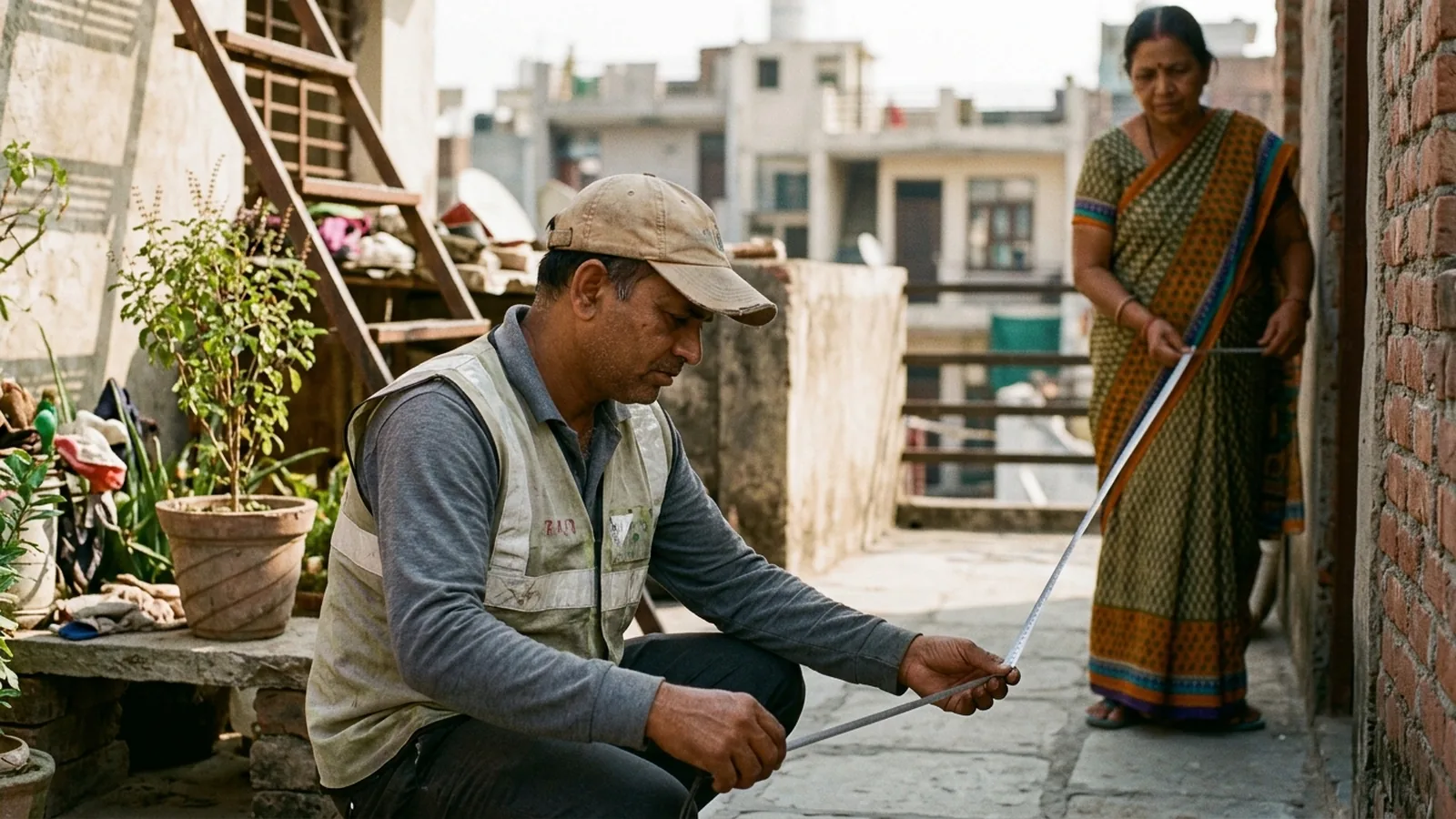
RCC flat roof, sloping sheet, or a terrace already crowded with water tanks? Is there a taller building or a large tree to the south? The agent should not judge feasibility; it records the answer so the surveyor arrives prepared.
5. How do you plan to pay?
Ask whether they would pay upfront or want a loan. When the scheme was approved, the government said collateral-free loans at around 7% would be available for residential systems up to 3 kW. A lead who says "only if it's free" is useful information too: they need education, not a survey.
6. Who decides, and by when?
In many Indian homes the decision is made jointly, often with a family member who is not the one who filled the form. Ask who should be present at the survey and how soon they want it. "Before summer" and "just checking" are very different leads.
Ask only one question per turn and let the customer finish. In our own testing, a sales manager found that long, multi-part questions felt rushed even at normal voice speed. "Is it your own house?" followed by "And roughly how much is the monthly bill?" gets cleaner answers than both at once.
How should the PM Surya Ghar subsidy come up on the call?
State the official central subsidy figures, say it applies to residential rooftop systems, explain that the household applies through the National Portal, and avoid promising eligibility. Accurate numbers build trust; "completely free solar" claims create angry customers when the paperwork reality arrives.
According to the February 2024 cabinet approval, the scheme covers 60% of system cost for 2 kW systems and 40% of the additional cost between 2 and 3 kW, capped at 3 kW. At the benchmark prices then, that meant ₹30,000 for 1 kW, ₹60,000 for 2 kW and ₹78,000 for 3 kW or higher. The scheme aims to provide up to 300 units of free electricity a month. Some states add their own incentives on top.
For an AI agent, the PM Surya Ghar subsidy belongs in the locked fact set, word for word, with a date for when it was last checked. We give each project or product its own locked facts after an early real-estate setup where one agent loaded facts from several projects and mixed up prices and locations. A solar company selling both residential and commercial systems should run them as separate agents, so subsidy talk never reaches a commercial buyer.
How do you book a solar site survey on the first call?
Solar site survey booking works best on the same call. Once the six answers look good, offer two or three specific slots, confirm the address with a landmark, check who will be present, and send a confirmation on WhatsApp. Write everything to the sheet so the surveyor sees the bill, roof type and payment plan before arriving.
- Call within minutes. Connect your lead source so new enquiries are dialled while the person still remembers the ad.
- Confirm interest and language. Open in the region's likely language and switch only if the customer replies in a full sentence in another.
- Ask the six questions. One per turn, in order, skipping any already answered on the form.
- Score and route. Strong leads move to booking; weak ones get a polite nurture message and a later call-back.
- Offer specific slots. "Saturday 11 AM or Monday 4 PM?" works better than "When are you free?"
- Confirm the details. Address, landmark, who will be present, and a phone number for the surveyor.
- Send and record. WhatsApp confirmation through your provider, outcome written back to your sheet, recording and summary saved.
This mirrors how we book site visits for a plotted-development company in North Karnataka, where agents call enquiries in Kannada, Hindi and English and book visits on the first call. Our article on booking a site visit on the first call and the appointment setter feature cover the mechanics.
Here is a hypothetical example of the middle of a qualification call, translated from Hindi:
- Agent: Is this your own house, Ramesh ji?
- Lead: Yes, independent house, two floors.
- Agent: Thank you. Roughly how much is your monthly electricity bill?
- Lead: About ₹3,500 in summer.
- Agent: Understood. Would you pay for the system directly, or would you like to know about loan options?
- Lead: Loan would help.
- Agent: Our team can explain those during the survey. Shall I book Saturday at 11 AM or Monday at 4 PM?
Common mistakes in solar lead qualification
The usual mistakes are calling too late, asking all six questions as a rapid-fire form, promising "free" solar, surveying homes the caller does not own, booking surveys without the decision-maker present, and mixing residential and commercial facts in one script or agent.
- Calling the next day. By then the lead has spoken to two other installers.
- Interrogation tone. Six questions in a row without acknowledgement feels like a form. Add a short "Thank you, that helps" between them.
- Overselling the subsidy. Quote official figures; say eligibility is confirmed through the application.
- Surveying tenants. Question 1 exists to prevent this.
- No call-back time. If the person is busy, book the time they ask for instead of retrying at random.
- Assuming gender. Use the name with "ji" or "avare". Calling a woman "Sir" was one of the clearest failures our testers flagged.
What does AI-led solar lead qualification cost, and where does it fall short?
A two-minute qualification call costs roughly ₹12–16 plus GST on our plans, billed in 30-second pulses, with unanswered calls not billed. AI handles first-call speed and consistent questions well. Technical questions about structure, inverters or net-metering disputes should go to your engineer.
The plan minimum and setup fee are on our pricing page. For a wider look at how we work with installers, see AI calling for solar companies and our AI calling playbook.
Good solar lead qualification sends surveyors to the right roofs and gives every other lead a polite next step instead of silence. If you want to hear six questions asked in your customers' language, book a 20-minute demo and we'll call your phone with an agent set up for your business.
Frequently asked questions
What questions should I ask to qualify a rooftop solar lead?
Ask six things: do you own the house and control the roof, what is your monthly electricity bill or units, is the connection in your name and with which DISCOM, what kind of roof and shade-free space you have, how you plan to pay (cash or loan), and who decides and by when. The answers tell you whether a site survey is worth booking.
How much is the PM Surya Ghar subsidy?
According to the Government of India's cabinet approval in February 2024, the central subsidy is ₹30,000 for a 1 kW system, ₹60,000 for 2 kW and ₹78,000 for 3 kW or higher, capped at 3 kW. Households apply through the National Portal. Some states add their own incentives, so check current details on the official portal.
Should an AI agent promise customers the subsidy on the first call?
No. The agent should explain the central subsidy amounts accurately, say that eligibility is confirmed through the official application process, and avoid words like 'guaranteed' or 'completely free'. Promising the subsidy before checking the connection, roof and paperwork creates disappointed customers and complaints later.
Can an AI agent book a solar site survey?
Yes. Once the lead answers the qualification questions, the agent offers available survey slots, confirms the address and a landmark, books the slot and writes it to your sheet or CRM. A WhatsApp confirmation can follow through your own provider, and the survey team sees the qualification answers before they visit.
What does an AI qualification call cost for a solar company?
On DigitalCallers plans, a two-minute conversation costs roughly ₹12–16 plus 18% GST, billed in 30-second pulses. Unanswered calls are not billed. Each plan has a one-time setup fee and a monthly minimum of minutes, listed on our pricing page. Compare that with the cost of a surveyor visiting a home that cannot install.
We build and run AI calling agents for Indian businesses from Gurugram, in Hindi, English and regional languages. Our articles draw on calls we have run ourselves and link to primary sources such as TRAI, DoT and MeitY for anything regulatory. Spotted something out of date? Write to support@digitalcallers.com.
See it on your own leads
In a 20-minute demo we set up an agent for your business and call your phone while you watch.