Part of our guide: AI Calling in India: The Complete 2026 Guide
Key takeaways
- Score every call on the same 14 parameters: 9 weighted items that add up to 100, plus 5 compliance gates that fail the call outright.
- Wrong facts and compliance slips come first, a missed next step second, talk ratio and polish last.
- If you audit by hand, pick calls on purpose (random, longest, shortest connected, lost), not only at random.
- Let AI scoring read every call and flag the risky ones; keep humans for disputes, tone and coaching.
- Audit your AI agents too: wrong facts, language switching, monologues and repeated lines.
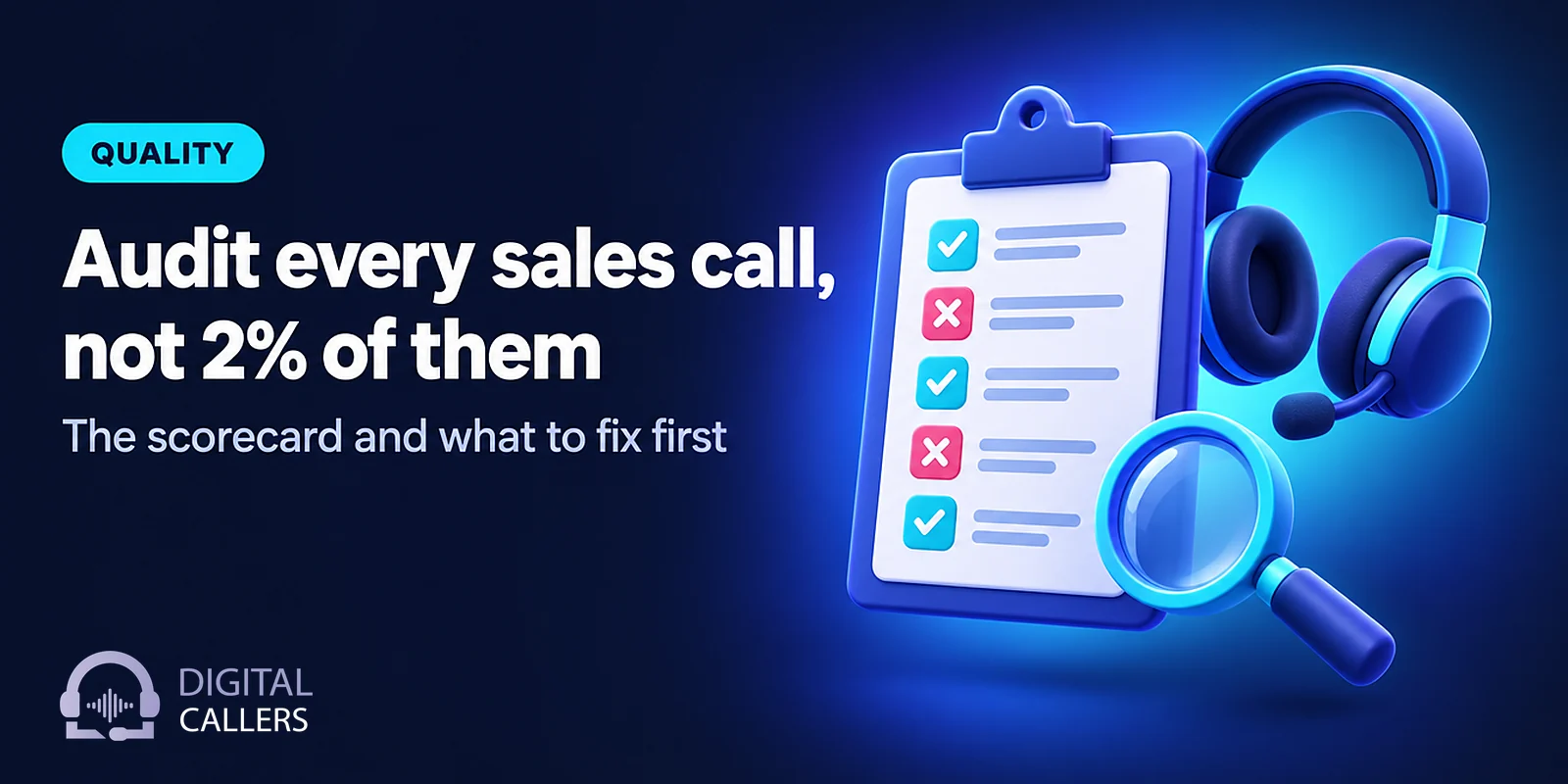
A call audit is a structured review of a recorded sales call against a fixed scorecard, so you can see whether your callers open well, ask the right questions, give correct facts, stay compliant and close on a clear next step. Most teams do it by having a manager listen to a handful of calls on a Friday, which tells you very little. This guide gives you a copy-ready scorecard with weights and pass/fail rules, a sampling method for manual audits, a way to check every call with AI scoring, and a clear order for what to fix first. If your calls already run on our platform, each one arrives with a recording, transcript, outcome and scored summary in conversation insights, which makes most of this a reading job rather than a listening marathon.
What is a call audit, and why is checking a few calls not enough?
A call audit is a quality check of real calls against a written standard, and a small sample is not enough because the costliest mistakes are rare. A rep who promises a guaranteed loan approval once a week will look perfect in most samples. You need either a smarter sample or full coverage.
Small samples are the norm, not the exception. In a Call Centre Helper reader poll of 113 contact centres (September 2016), 35% said they evaluate one percent or less of their interactions for quality, and another 33% said one or two percent. An earlier IBM research paper on automated quality monitoring for call centres (Zweig et al., NAACL 2006) put it even lower, noting that typically only "a fraction of a percent" of calls is evaluated.
Do the arithmetic for your own team. Say a telecaller in Jaipur makes 60 connected calls a day, five days a week: 300 calls. A 2% sample is six calls. If that rep skips the recording disclosure on one call in fifty, there is a good chance none of those six shows it.
What should a call audit checklist include?
A good call audit checklist covers six areas: opening, discovery, product facts, objection handling, compliance, and next step with data capture. Weighted items measure quality; compliance items work as gates that fail the call regardless of score. Copy the table below and change the weights to suit your sales motion.
| # | Area | Parameter (call audit parameters) | Weight | Pass rule |
|---|---|---|---|---|
| 1 | Opening | Greets by name, says who is calling and why, asks if now is a good time | 10 | All three present; a "call me later" is honoured with a time |
| 2 | Opening | Opens in the customer's likely language and switches only when the customer does | 5 | No wrong-language opening; no switching on a stray word |
| 3 | Discovery | Asks two or three qualifying questions, one per turn | 10 | Budget, need or timeline covered as your process requires |
| 4 | Discovery | Listens: no talking over the customer, no long monologues | 10 | Customer gets a turn after every point; no unanswered question |
| 5 | Product facts | Every price, offer, location and timing matches the approved facts sheet | 15 | Any wrong fact is a critical fail (see rules below) |
| 6 | Objection handling | Acknowledges, answers with one useful fact, returns to the next step | 10 | No arguing, no ignoring, no pressure |
| 7 | Next step | Proposes a specific next step (visit, demo, call-back) with day and time | 20 | A dated next step, or a clear "not interested" recorded |
| 8 | Next step | Confirms the next step back and ends with a proper goodbye | 5 | Slot repeated; no abrupt hang-up |
| 9 | Data capture | Outcome, fields and notes recorded correctly in the CRM or sheet | 15 | Matches what was said on the call |
| G1 | Compliance | Identifies self and company at the start | Gate | Must pass |
| G2 | Compliance | Call placed within your approved calling hours, or at the time the customer asked for | Gate | Must pass |
| G3 | Compliance | Recording disclosure or consent given as your policy requires | Gate | Must pass |
| G4 | Compliance | Opt-out respected: "don't call me" is acknowledged and recorded | Gate | Must pass |
| G5 | Compliance | No false promises: no guaranteed returns, approvals, discounts or "last unit" claims that are not true | Gate | Must pass |
How do you score the scorecard?
Score each weighted item as Yes (full marks), Partial (half) or No (zero), then apply three rules:
- Any gate fails, the call fails. Score it zero, flag it the same day and listen to the full recording before talking to the rep.
- Any wrong fact on item 5 fails the call too. Then check whether the rep or the facts sheet was wrong. Often it is the sheet.
- Otherwise, 80 and above passes, 60 to 79 goes to coaching, below 60 fails.
Keep the scorecard unchanged for a month so scores stay comparable. For the wording side of opening, discovery and booking, our AI calling script template has a fill-in flow; the audit checks whether calls follow it.
How should you sample calls if you audit by hand?
Sample on purpose, not purely at random: a fixed number per caller per week, drawn from different kinds of calls. Random picks tell you what an average call sounds like. Targeted picks find the problems. You need both.
A workable weekly mix for each caller:
- Two random connected calls, for a fair baseline.
- The longest call of the week. Long calls hide monologues, arguments and over-promising.
- One short connected call (under a minute). These show weak openings and wrong-language starts.
- One lost deal, complaint or "not interested". This is where objection handling and pressure show up.
That is five calls per caller, or 40 a week for a team of eight. Read transcripts first and listen only to the flagged parts. Rotate who audits whom so one manager's taste does not become the standard.
Before the first audit, have two managers score the same five calls separately and compare. Where they disagree by more than one Partial, rewrite that parameter's pass rule until they agree. A scorecard two people read differently will start arguments, not improvements.

How do you audit 100% of calls with AI scoring?
You let software score every call and use the scores as a filter, so humans listen only to calls that are flagged, disputed or useful for coaching. Coverage comes from the machine; judgement stays with people.
On our platform, every call already carries a recording, a transcript, an outcome and a scored summary in conversation insights. A sensible workflow on top of that:
- Read the low scores daily. Anything with a missing next step, a "don't call" outcome or a short, abrupt ending gets a quick listen.
- Search transcripts for risk words your business cares about: "guarantee", "pakka", "100%", "approval", "discount", "last flat". Check each hit against the facts sheet.
- Spot-check high scores weekly. A few top-scored calls each week keeps the scoring honest.
- Settle disputes by ear. If a rep says the score is wrong, a manager listens and decides. Note the call so you can tune the rule.
- Coach live when it matters. For new reps or high-value leads, a manager can listen in, whisper to the caller, or take over through the live monitor.
Treat every machine score as a prompt to look, never as a verdict on a person.
What should you fix first?
Fix compliance slips and wrong facts first, then missed next steps, then talk ratio and style. The order follows the cost of the mistake: a false promise can lose a customer and invite a complaint, a missed next step loses a deal quietly, and a poor talk ratio mostly lowers conversion over time.
| Priority | What the audit found | Typical fix | Fix by |
|---|---|---|---|
| 1 | Gate failure: no self-identification, no disclosure, opt-out ignored, false promise | Same-day conversation, script line added, DNC list updated | Today |
| 1 | Wrong price, offer or location | Correct the facts sheet first, then brief the team | Today |
| 2 | No dated next step | Add a two-option booking line ("Saturday 11 baje ya Sunday 4 baje?") | This week |
| 2 | Outcome or fields wrong in the CRM | Simplify the outcome list; fewer, clearer options | This week |
| 3 | Rep talks too much, interrupts | Coach with one recording, one target behaviour | Next two weeks |
| 3 | Weak opening, stiff tone | Role-play and rewrite the first two lines | Next two weeks |
Objection handling sits in the middle: a pushy reply can become a compliance issue, while a weak one is a coaching point. Our guide to objection handling on sales calls covers better replies, so the audit only needs to flag which objections are going wrong.
On compliance, keep the facts straight and the advice with your adviser. Calling hours and opt-outs are covered in our guide to avoiding spam flags on business calls. Under India's Digital Personal Data Protection Act, 2023, a recording of an identifiable caller is personal data, so notice, purpose and retention all matter; our DPDP call recording checklist walks through the steps. This is general information, not legal advice.
How do you run a weekly 30-minute call review?
Keep it to one meeting, same day each week, with a fixed agenda and no more than three calls played. The point is to agree one or two changes and assign them, not to replay the week.
| Minutes | Agenda item |
|---|---|
| 0–5 | Gate failures and wrong facts from the week: what happened, what was fixed |
| 5–15 | Play two short clips: one good, one to improve, on the same parameter |
| 15–22 | Scorecard trends: which parameter dropped, which caller or campaign |
| 22–27 | Agree one change to the script, facts sheet or outcome list |
| 27–30 | Owners and dates; note what to check next week |
Play clips, not whole calls. Praise in the room, correct in private. Next week, check whether last week's change actually moved the score.
How do you audit AI agents as well as human callers?
Use the same scorecard for AI agents and add four checks that catch how machines fail: wrong facts said confidently, language switching on a stray word, long monologues, and repeated lines after an interruption. AI agents rarely skip a step out of tiredness, but they do exactly what their script and facts allow, including the mistakes.
What we look for on our own agents, and on any AI telecaller you run:
- Wrong or mixed facts. An agent that has facts for several projects or products can mix prices and locations. One agent per project, with its own locked facts sheet, fixes most of it.
- Language switching. The agent should switch only when the customer speaks a full sentence in another language, not on "haan" or "hello". Saying the same line twice in two languages sounds broken.
- Long monologues. In our own call data, recent sales conversations had a median of about 122 seconds. A 30-second answer is a quarter of that. Flag any turn that runs on without giving the customer room to reply.
- Repeated lines. When a customer says "hello?" mid-sentence, a weak agent restarts its whole line. Search transcripts for the same sentence appearing twice in a row.
The fix for AI failures is usually in the script, the facts sheet or a setting, not in coaching, so route AI findings to whoever owns the agent's set-up.
What changes when calls are in Hinglish or regional languages?
The scorecard stays the same, but your auditors need to understand the language of the call, and your risk words need translating. In Hinglish, "guaranteed" may show up as "pakka", "confirm hai" or "tension mat lo".
- Match auditors to languages. If a Pune team calls in Marathi, at least one reviewer should be a fluent Marathi speaker.
- Translate your gate phrases. Write the opt-out phrases customers actually use ("mujhe call mat karo", "number hata do") and make sure each one is recorded as an opt-out.
- Judge the language choice itself. Opening in English with a caller in Lucknow who replies in Hindi is a parameter 2 miss, even if everything else is fine.
Our agents speak Hindi, English, Hinglish, Marathi, Kannada, Tamil, Telugu and Bengali; our guide to multilingual AI calling explains how switching works on a live call.
Common mistakes in call quality audits
Most call quality audits fail because the scorecard is vague, the sample is too thin, or findings never reach the script and facts sheet.
- Scoring "tone" or "confidence" with no pass rule. If two managers cannot agree, drop it or define it.
- Treating every miss as equal. A missed goodbye and a false promise should not cost the same five points.
- Blaming the rep for a wrong facts sheet. Fix the source first.
- Never closing the loop. If an audit finding does not change a script line, a fact or a habit within two weeks, the audit was wasted time.
Start your call audit this week
Copy the scorecard, agree the pass rules with one other manager, and score five calls per caller this week using the sampling mix above. Book the 30-minute review for a fixed weekly slot. After a month, the parameters that keep failing are your fixes, in the priority order above.
If your calls are recorded but nobody has time to listen, that is where full coverage pays off. Every call on our platform comes with a recording, transcript, outcome and scored summary in conversation insights, so your managers spend their time on the calls that need them. Book a 20-minute demo and we'll show you how a week of calls looks when every one of them is checked.
Frequently asked questions
What is a call audit?
A call audit is a structured review of a recorded call against a fixed scorecard. The reviewer checks whether the caller opened properly, asked the right questions, gave correct facts, followed compliance rules and agreed a clear next step. The aim is to find patterns you can coach or fix, not to catch individuals out.
How many calls should a manager audit each week if it is done by hand?
A workable minimum is five calls per caller per week, chosen on purpose rather than at random. Take two random calls, the longest call, one short connected call and one lost or complained-about call. That is enough to spot habits; it is not enough to catch rare compliance slips, which is why scoring every call helps.
What are the most important call audit parameters?
Compliance and factual accuracy come first, because one false promise or wrong price can cost a deal or invite a complaint. After that, a specific agreed next step and correct data capture matter most for revenue. Talk ratio, tone and opening polish matter, but they are coaching points, not emergencies.
Can AI scoring replace human call auditors?
No. AI scoring is good at reading every call and flagging the ones that need a human ear, but people should still settle disputed scores, judge tone and context, and do the coaching. A sensible split is machines for coverage and humans for judgement.
Should AI voice agents be audited the same way as telecallers?
Yes, using the same scorecard, with a few extra checks. AI agents rarely forget a step, but they can state a wrong fact confidently, switch language on a stray word, deliver long monologues or repeat a line after an interruption. Add those four checks to the scorecard for every AI agent you run.
We build and run AI calling agents for Indian businesses from Gurugram, in Hindi, English and regional languages. Our articles draw on calls we have run ourselves and link to primary sources such as TRAI, DoT and MeitY for anything regulatory. Spotted something out of date? Write to support@digitalcallers.com.
See it on your own leads
In a 20-minute demo we set up an agent for your business and call your phone while you watch.