Part of our guide: AI Calling Cost in India: Pricing Models, Real Numbers and ROI
Key takeaways
- About 61% of 42,879 outbound calls lasted 15 seconds or more, our proxy for a real connection. It is a proxy, not a verified pickup rate.
- 12–3 PM IST did best (about 61–65%), 3–6 PM was close (59–64%), and 10–11 AM was weakest (52–54%).
- Thursday (about 68%) and Wednesday (65%) led; Saturday (53%) and Sunday (56%) trailed.
- Recent AI sales conversations ran about two minutes (median ~122 seconds, small sample).
- The data mixes campaign types and industries, so test these patterns on your own leads.
Many AI calling statistics India readers come across are global surveys or figures with no published method. So we looked at our own: 47,731 calls handled on the DigitalCallers platform between May and October 2026. Two findings surprised us. Mid-morning was the weakest hour slot we measured, and weekends, which many sales teams treat as prime calling time, came last.
AI calling statistics India: how did we collect the data?
We counted every call handled on our platform from May to October 2026: 47,731 in total, of which 42,879 were outbound and 4,852 inbound. The calls came from several Indian businesses, mostly real estate, plus health and wellness and B2B services. We used call duration of 15 seconds or more as a proxy for a connection.
Here is the dataset in one view:
| What we measured | Figure |
|---|---|
| Period | May–October 2026 |
| Total calls handled | 47,731 |
| Outbound calls | 42,879 |
| Inbound calls | 4,852 |
| Outbound calls lasting 15 seconds or more | 26,098 (≈61%) |
| Inbound calls lasting 15 seconds or more | About half |
| Industries | Mostly real estate; also health/wellness and B2B |
| Time zone for hour analysis | IST |
Why 15 seconds?
Our call records tell us how long each call lasted, not whether a human picked up. A call that ends in a few seconds is rarely a conversation: it is a rejection, a network drop or silence. A call that lasts 15 seconds or more usually means someone heard the opening and responded. So we use "15 seconds or more" as a working proxy for a connection.
It is imperfect in both directions. Some calls over 15 seconds may be a voicemail greeting or a person who listened briefly and hung up. Some genuine answers ("not interested", click) end sooner. We use it because it is consistent across campaigns, which makes comparisons between hours and days fair, even if the absolute number isn't a true pickup rate.
What kinds of campaigns are in the data?
This is AI call data from real work, not a controlled experiment. Calls include real-estate lead follow-up and site-visit booking (including in Kannada, Hindi and English), a Kannada-only event-invitation campaign for a developer's ground-breaking ceremony, a D2C health and wellness brand's funnel leads, and B2B calling. A large share of July–August volume was those short scripted event invitations, which matters for call length, as you'll see below.
What share of AI calls connect in India?
Across 42,879 outbound calls, 26,098 lasted 15 seconds or more, so our call connect rate India-wide, on this proxy, was about 61%. Inbound was lower, with about half of 4,852 calls lasting 15 seconds or more. These are platform-wide figures across mixed campaigns, not a promise for any single list.
Roughly six in ten outbound calls reaching a real conversation is a useful planning number, but treat it with care. Our customers mostly call people who recently enquired: a Facebook or Instagram lead form, a brochure request, a funnel sign-up. We'd expect fresh, opted-in leads to answer more readily than cold lists, though we have no cold-list data to compare. If you are calling older or purchased data, expect different results, and read the legal side first.
The inbound figure surprised some customers. A call that someone else starts should be a sure connection, so why is only about half 15 seconds or more? The data doesn't tell us why. Plausible reasons include people calling back a missed number, hearing a greeting and hanging up, and quick wrong-number calls, but we haven't measured these separately, so we won't claim a cause.
What is the best time to call leads in India?
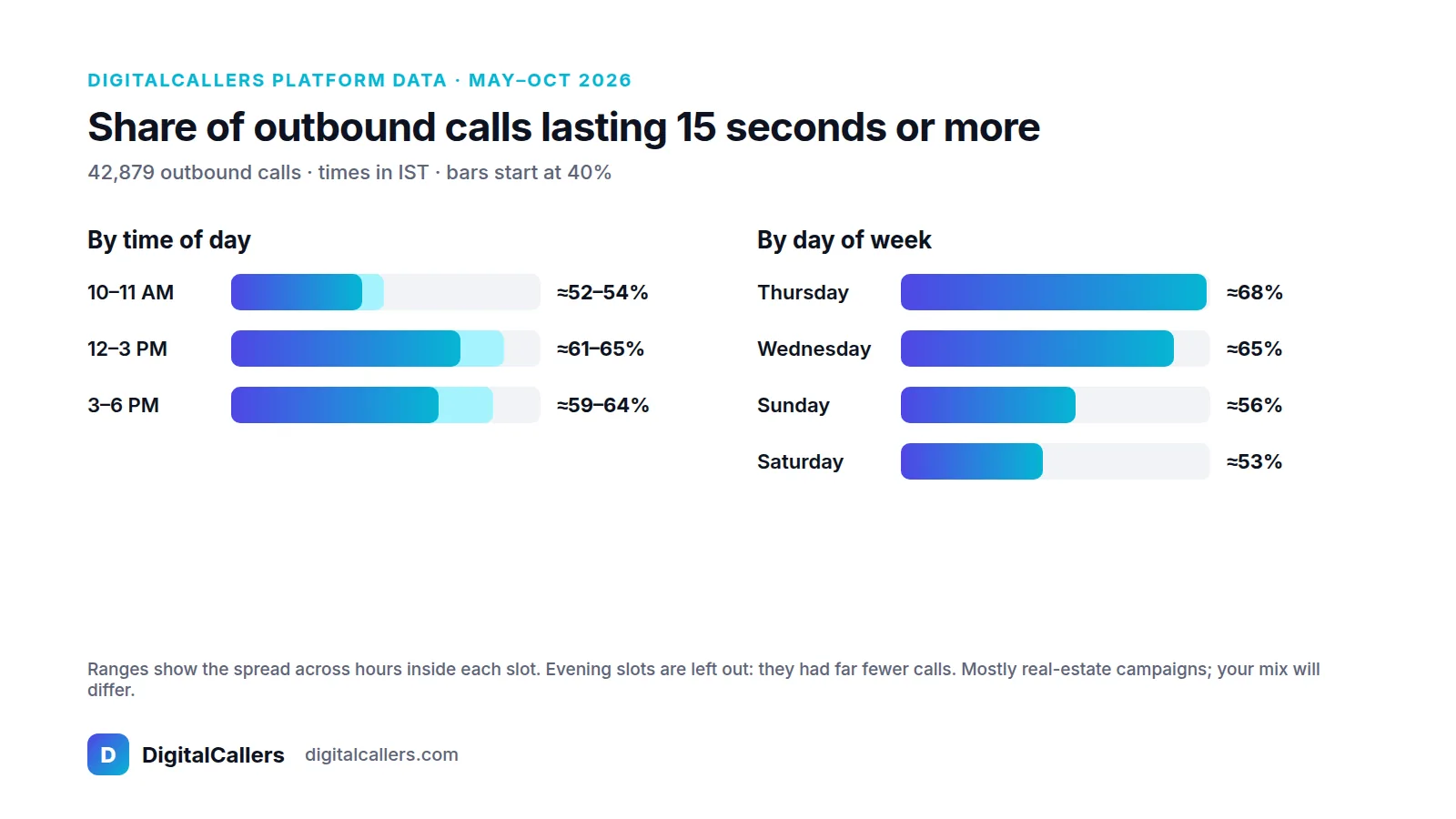
In our outbound data, the best time to call leads India-wide was the early afternoon: 12–3 PM IST, when about 61–65% of calls lasted 15 seconds or more. 3–6 PM was close behind at 59–64%. The 10–11 AM slot was weakest at about 52–54%. Evening slots looked higher but on far fewer calls.
| Time slot (IST, outbound) | Share of calls lasting 15s+ |
|---|---|
| 10–11 AM | ≈52–54% |
| 12–3 PM | ≈61–65% |
| 3–6 PM | ≈59–64% |
| Evening slots | Looked higher, but on far fewer calls |
Mid-morning being the weakest slot runs against a common instinct to "start calling at 10 sharp". One plausible explanation is that people are commuting, opening shops or in their first meetings, but our data shows the pattern, not the reason.
We don't recommend shifting everything to the evening on this evidence. The evening slots had far fewer calls, so a few good days can make them look better than they are. We'd want much more volume before trusting them.
Which days of the week get the most answers?
Midweek did best. Thursday had the highest share of outbound calls lasting 15 seconds or more, at about 68%, followed by Wednesday at about 65%. Weekends were weakest: Saturday at about 53% and Sunday at about 56%. Monday, Tuesday and Friday sat between those highs and lows.
| Day (outbound) | Share of calls lasting 15s+ | Where it ranked |
|---|---|---|
| Thursday | ≈68% | Highest |
| Wednesday | ≈65% | Second highest |
| Sunday | ≈56% | Second lowest |
| Saturday | ≈53% | Lowest |
This matters most in real estate, where weekends are often treated as the time to reach buyers. Our data shows the weekend dip but not its cause. For our North Karnataka real-estate deployment, the site is open Monday to Saturday, so a call that books a Saturday site visit on a Wednesday or Thursday fits the pattern well. Our real-estate lead follow-up guide covers timing in more depth.
How long do AI calls last?
Across the whole period, the median call was short, around 30–41 seconds, because many July–August calls were scripted event invitations of 40–45 seconds. Recent sales conversations in October 2026 ran much longer, with a median of about 122 seconds, roughly two minutes, on a small sample.
The lesson is that an "average call length" means little unless you know what kind of calls are in it. A reminder or invitation call should be short. A qualification call that asks about budget, location and timing and then books a site visit naturally runs to about two minutes.
That length has a direct cost implication. On our pricing, a two-minute sales conversation costs roughly ₹12–16 and a short confirmation call under a minute costs ₹3–8, plus GST, with unanswered calls not billed. See how per-minute and pulse billing work or our pricing page for the detail.
What did the calls themselves teach us?
Numbers tell you when people answer; recordings tell you why they stay. A sales manager who tests our calls gave us direct feedback, and each point led to a change in how we build agents. The common thread: short turns, the right language from the first line, and respectful address.
| What went wrong | What we changed |
|---|---|
| Long monologues felt rushed, even at normal voice speed | One or two sentences per turn, one number per turn, then stop and listen |
| A "hello?" mid-sentence made the agent restart its whole line | Shorter turns, which cured most of the repetition |
| Calling a woman "Sir" repeatedly | Use the person's name with "ji" or "avare"; never assume gender |
| Saying the same thing in two languages back to back | Switch language only on a full sentence, not a stray "haan" |
| Wrong default language made one agent go silent at the start | Set and test the opening language before go-live |
| Hanging up without a goodbye | The platform now holds the hang-up until the goodbye finishes |
One more lesson came from setup rather than calls. An early agent loaded facts from several projects and mixed up prices and locations between them. We now give each project its own agent with its own locked facts. You can see call-level patterns like these in conversation insights.
How does this compare with outside benchmarks?
We could not find a published, verifiable Indian benchmark for AI call connect rates, so we haven't compared our 61% with one. The outside figures below give context on the Indian calling environment instead: how many phones there are, and how much unwanted calling people already receive.
These are external figures, separate from our platform data:
- India had 1,360.70 million telephone subscribers at the end of August 2026, according to TRAI's telecom subscription data released on 28 September 2026.
- In a LocalCircles survey reported in September 2024, 95% of mobile users said they received unwanted calls daily, and 77% said three or more a day.
- TRAI data cited by Upstox in September 2026 says AI systems flagged about 771 crore calls as suspected spam in April 2026.
Put together, they explain why connection rates are not higher: people are wary of unknown numbers. Calling people who actually asked to hear from you, quickly and from a consistent number, is the practical response. Our guide on avoiding the spam flag goes further.
What can't these numbers tell you?
These AI calling statistics India businesses can use come with honest limits. The campaigns were mixed, so hour and day patterns partly reflect which campaigns ran when. Duration is a proxy for connection, not proof of it. Results vary by industry, list quality and time of day, and most calls were real estate.
What this means for your 2026 calling strategy
Start calling fresh leads quickly, weight your calling towards midday and midweek, keep conversations to about two minutes with short turns, and measure your own connect rate by hour and day rather than borrowing anyone's. Use our numbers as a starting hypothesis, then test.
- Shift volume towards 12–6 PM. Both afternoon slots beat 10–11 AM by several points in our data. Keep mornings for retries, not first attempts.
- Put first attempts midweek where you can. Wednesday and Thursday led; weekends trailed. For weekend site visits, try booking them on Wednesday or Thursday.
- Design for a two-minute conversation. Our recent sales calls had a median around 122 seconds. Scripts that need five minutes are probably trying to do too much.
- Track your own 15-second rate by slot. It costs nothing to compute from call logs and quickly shows whether your audience behaves like ours.
- Fix the conversation before buying more volume. Short turns, correct opening language and respectful address keep people on the line longer than any timing tweak.
Split your connect-rate report by campaign type before comparing hours. A week of short reminder calls can make one slot look brilliant or terrible for reasons that have nothing to do with the time.
Common mistakes when reading call statistics
The biggest mistake is treating someone else's numbers as yours. Others include reading a duration proxy as a pickup rate, trusting slots with little volume, mixing campaign types in one average, and ignoring list quality. Each of these can make a good calling plan look bad, or the reverse.
- Borrowing benchmarks. Our customers mostly call recent, opted-in enquiries in real estate, wellness and B2B. A cold list in another industry will behave differently.
- Confusing proxies with facts. "Lasted 15 seconds" is not "a human answered".
- Trusting thin data. Our evening slots looked strong on few calls, which is exactly why we don't recommend them yet.
- Averaging different campaigns. Event invitations and sales calls should never share one "average call length".
AI calling statistics India businesses can trust are the ones from their own calls. If you want to see these patterns on your leads, with call results written back to your sheet, book a 20-minute demo and we'll call your phone with an agent set up for your business. For the cost side, start with our guide to AI calling cost in India.
Frequently asked questions
What is a good call connect rate for AI calling in India?
On our platform, about 61% of outbound calls from May to October 2026 lasted 15 seconds or more, which we use as a proxy for a real connection. That is one set of data across mixed campaigns, not an industry benchmark. Your rate will depend on list quality, how fresh the leads are, industry and time of day.
What is the best time to call leads in India?
In our outbound data, the 12–3 PM IST slot did best, with about 61–65% of calls lasting 15 seconds or more, followed by 3–6 PM at about 59–64%. The 10–11 AM slot was lower, at about 52–54%. Evening slots looked higher but on far fewer calls, so we don't rely on them yet.
Which day of the week is best for calling leads?
Thursday was the strongest day in our data, at about 68% of outbound calls lasting 15 seconds or more, followed by Wednesday at about 65%. Saturday, at about 53%, and Sunday, at about 56%, were the weakest. Treat this as a starting point and test on your own leads.
How long does an AI sales call last?
Recent AI sales conversations on our platform in October 2026 had a median of about 122 seconds, roughly two minutes, on a small sample. Across the full May–October period the median was much shorter, around 30–41 seconds, because many calls were short scripted event invitations rather than sales conversations.
Is a 15-second call the same as a human answering?
No. We use 15 seconds or more as a proxy because very short calls are usually not real conversations. Some calls over 15 seconds may still be voicemail or a quick hang-up, and some genuine answers may be shorter. It is a useful comparison measure, not a verified human pickup rate.
We build and run AI calling agents for Indian businesses from Gurugram, in Hindi, English and regional languages. Our articles draw on calls we have run ourselves and link to primary sources such as TRAI, DoT and MeitY for anything regulatory. Spotted something out of date? Write to support@digitalcallers.com.
See it on your own leads
In a 20-minute demo we set up an agent for your business and call your phone while you watch.